
Published Date: 26 November 2009 © Buxton Advertiser – Courtesy of the Buxton Advertiser. By Peter Low
MESSIAH is perhaps one of the most popular and well known compositions, having always been in the repertoire since its first triumphant performance in Dublin in 1742.
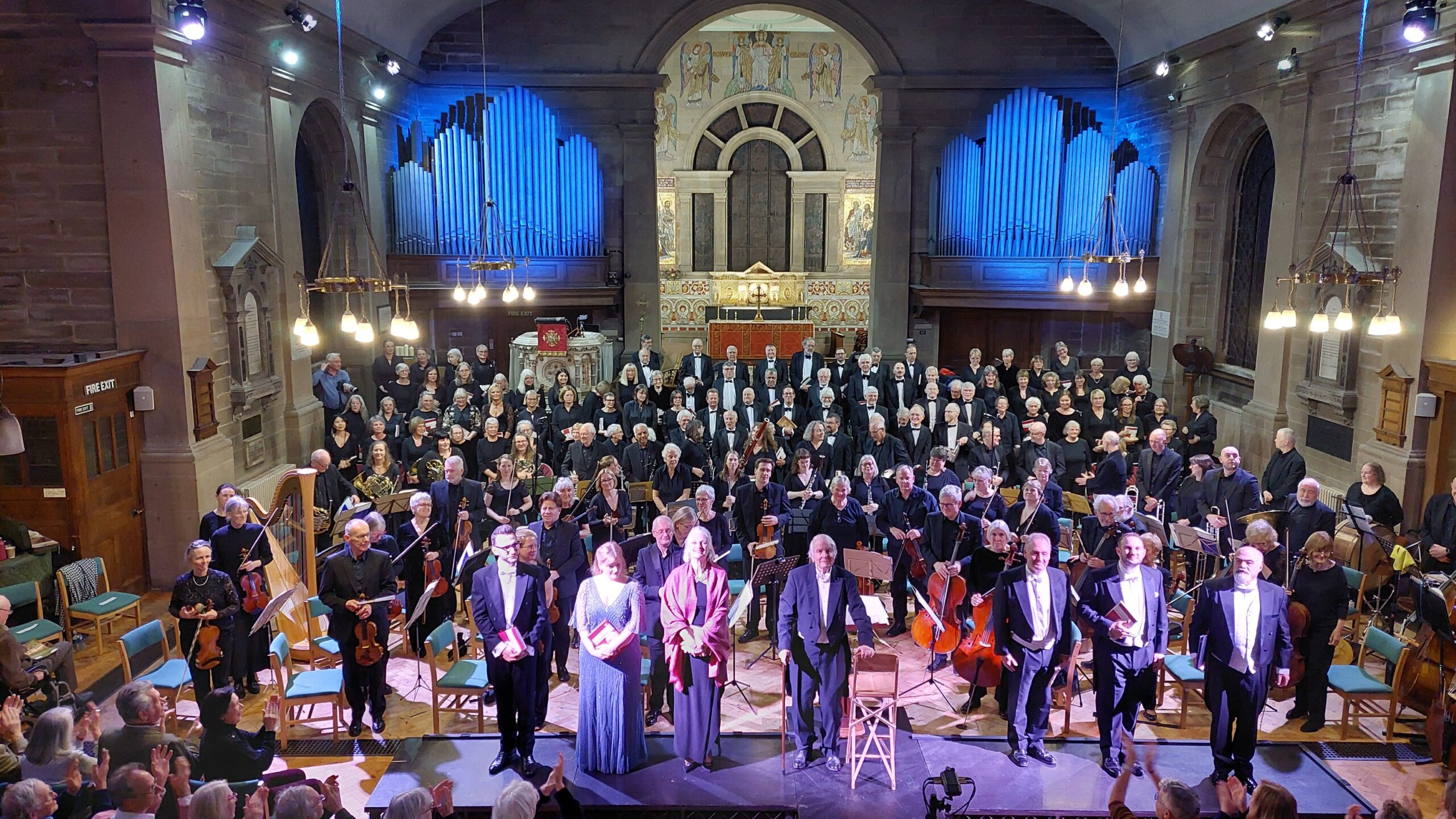
But the familiarity of the music should not make us forget that this is Handel's greatest work. And this was emphatically confirmed by the Musical Society's performance to a packed audience in St John's Church.
The last few productions of Messiah by the Society have relied on student soloists. For this performance, however, the society had engaged stunning professional singers.
Joshua Ellicot, making a welcome return to Buxton, has the most commanding tenor voice which he used to magical effect in the opening aria, thereby establishing the significance of the message conveyed by a work which, as the programme notes explained, is "almost entirely deprived of dramatic action".
And he was ably supported in this by Rachel Godsill, Soprano, valiantly standing in at very short notice for Helen Groves who was ill, Margaret Macdonald, Alto, and Marcus Farnsworth, a fine young Bass who captivated us with "The Trumpet shall sound", Ken Brown from the Hallé providing a superb trumpet obligato.
And it says something about the quality of the Musical Society that Ken had specifically asked if he could join the orchestra to play that.
Many amateur orchestras, while having good wind players, are frequently weak in the strings. The Buxton Orchestra strings, however, are unusual in that they can be relied on to produce a rich and warm sound – very important in Messiah where they are called upon to provide most of the accompaniment.
And Buxton is also fortunate to be able to call on such accomplished musicians for the continuo – David Francis, Harpsichord, and regular members of the orchestra Naomi Turner, 'Cello, and David Walker, Double Bass.
This is a work which most members of the choir know well so there is always a risk that their musical security might transpose into boredom. But Michael Williams has the skill to bring freshness to the performance. The enthusiastic audience response was an indication of the success of the occasion.
* The next performance of the Musical Society is their Carol Concert in the Opera House on Sunday December 13 at 7.30pm.
I Here
Published Date: 28 November 2008
By Peter Low
BUXTON Musical Society: Semele, St John's Church
Semele represented a new idea by which Handel overturned Italian Opera in London.
Intended to be performed with little or no action "after the manner of an Oratorio" but with an English text by Congreve based on Ovid's classical story of the amorous god Jupiter's affair with Semele, it was an instant success. And with this fine performance of the Musical Society we can see why.
The format inspired some of Handel's most appealing music; Semele in particular having a wealth of lovely airs, one of which, " Where'er you walk", must have been known to just about everyone in the audience.
However, what is perhaps less well known is the context of the song. It is, of course, Jupiter arranging arcadian delights for his beloved. It was sung with great sensitivity by Andrew Mackenzie Wicks.
All this behaviour was naturally not at all pleasing to Juno, sung by Susanna Spicer, who captured the understandable outrage of a wife with an errant husband. Susanna also took the role of Semele's sister Ino, helpfully donning a scarf to indicate the change of character. Semele herself (Helen Groves) falls neatly into the trap set by Juno and as a result the liaison with Jupiter is shattered.
It was an evening of truly marvellous singing from all the soloists and from the choir as well. A special word of praise also for the orchestra and in particular the strings who really had to work very hard indeed. But what a wonderful sound they produced. And, as we now expect, Michael Williams was always in firm control.
Published Date: 22 May 2008
Buxton Musical Society Concert
English Music, St John's Church, Sunday
WITH this programme the musical society showed convincingly that in the twentieth century this country has produced composers of great individuality and distinction.
The highlight of the evening was, without doubt, the Elgar 'cello concerto. Composed mainly in 1919, its bleakness and innate sadness reflected the general longing for peace after the dreadful carnage of the Great War. Elgar was shocked by the scale of the slaughter and he felt strongly that his Edwardian past had died also. " The world is a changed place & I am awfully tired of it", he wrote to a friend. It was to be the last of his major compositions. Simon Webb, making a welcome return to Buxton, caught this sense of disillusion and loneliness with great sensitivity particularly in the mournful adagio.
And with Michael Williams having established a near perfect balance between soloist and orchestra the result was one of the most moving of recent performances given by the Society.
The programme had opened with the rather more robust Britten orchestration of some pieces by Rossini entitled Soirees Musicales. The music is well known but Britten's handling of it made serious demands on the orchestra. That they played so competently demonstrates how good the Musical Society Orchestra has become. The orchestra then went on to show how they could also evoke the nostalgic rhapsody of Delius' Walk to the Paradise Garden.
Tippett's Spirituals from his Oratorio A Child of our Time let the choir show what they could do assisted by soloists Jane Mc Neill (soprano), Alison Syner (alto), Nicholas Scott (Tenor) and David Shipley (Bass) the latter from Buxton. He is in his first year at the Academy in London having travelled up to Buxton bringing his friend the tenor with him. He has a fine voice and it would be good to hear more of him in the future.
The Choir also gave us Vaughan Williams Benedicite with Frances Brindley as soloist. It is not an easy solo part particularly the final sustained high note but Francis sang with admirable assurance.
The programme closed with Elgar's anthem Give unto the Lord composed in 1914. It is Elgar in a somewhat bombastic mood but its contrast to the concerto shows the range of the composer's genius.
Peter Low
Courtesy: Buxton Advertiser
|